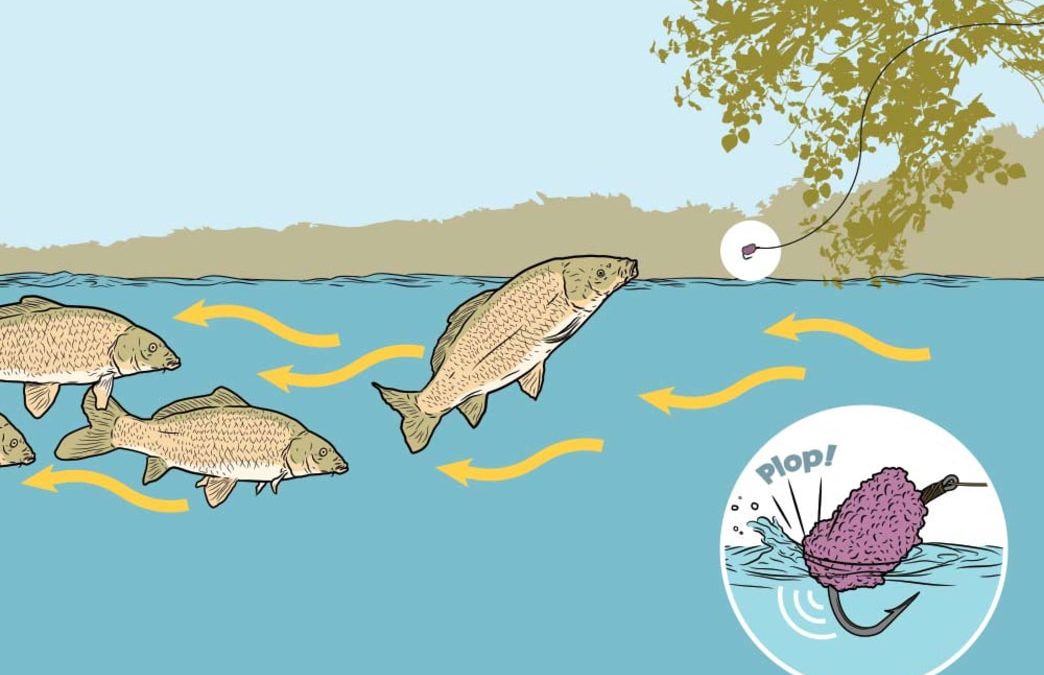
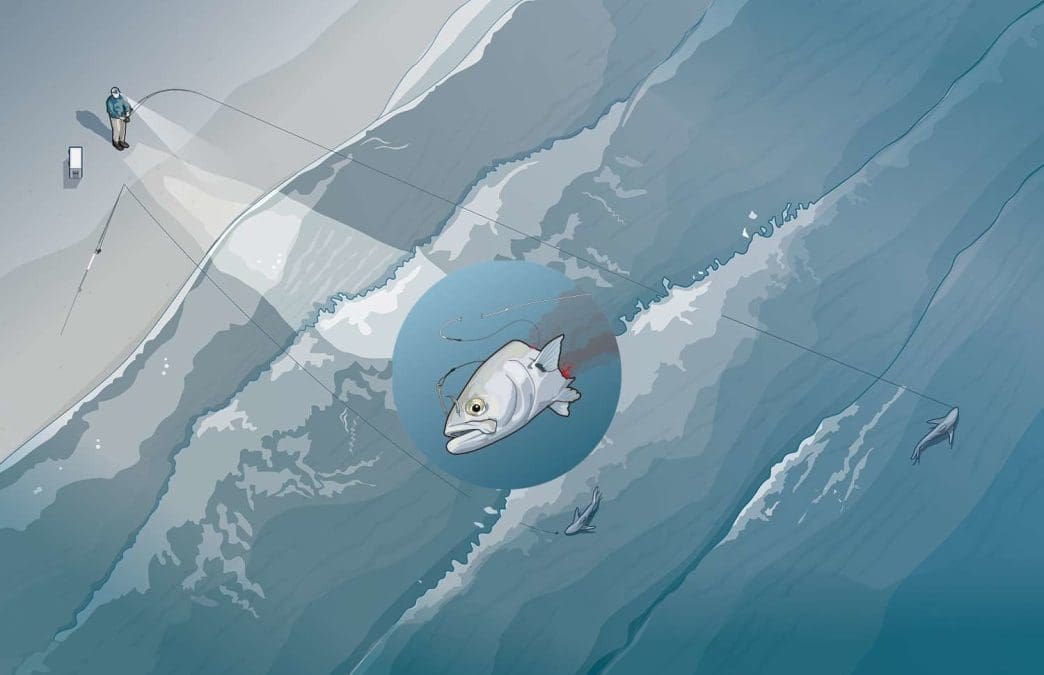
Carp are total jerks. Stalk them on the flats or in a clear river when they’re feeding on forage, like nymphs and crayfish, and they’ll snub your bugs, spook when you cast, and drive you to the brink of rod-snapping madness. Or you can look for some under a mulberry tree, where they’ll feed with the same carefree vigor as a school of farm-pond bluegills. Depending on where you live, mulberry trees fruit from May through August, and if there are branches overhanging a river, rest assured every single carp in the area knows where to find them. As the breeze shakes berries off the tree, the carp swarm, and they can get so focused on gulping the juicy morsels off the surface that they’ll let their normally expletive-inducing guard down. This is your chance to nail a golden giant on the fly. Here’s how.
It’s a Breeze
Wind is no friend of the fly-caster, but in the mulberry game, it can be your best buddy; the more berries hitting the water, the more frenzied the carp get. On days with a stiff breeze, I’ve witnessed dozens of carp lining up downstream of a tree like surface-feeding trout, moving in for a berry, then sliding to the back of the line to set up again. Of course, if there’s not a breath of wind, I may or may not have purposely snagged a tree a time or two just to give the branches a little shake and get the party started.
Sound Off
The plop of a mulberry hitting the water is what draws distant carp to the tree, and if your fly doesn’t closely match the surface-smacking tone of a natural berry, it can get refused—especially if the feeding activity isn’t hot and heavy. Carry foam berry flies with different densities—some cut from thick foam, others made of trimmed foam strips—so you can dial in the right notes. Color matters as well, so bring flies in a range from dark purple through bright red to match the current ripeness of the berries.
Short Lead
Usually when you’re flyfishing for carp, you want to lead the fish by a good distance, giving it time to find the fly on its own. But with mulberry flies, you want to practically hit the carp in the face. These fish have poor eyesight, so they’ll hear a berry, rise to sip it, and then drop back down. So pick a fish that’s moving toward the tree and plop your fly a foot in front of its snout. Most of the time that fish will strike; if it doesn’t, don’t expect it to follow your fly. Just strip in and be ready to cast at the next target.
Written by Joe Cermele for Field & Stream and legally licensed through the Matcha publisher network. Please direct all licensing questions to legal@getmatcha.com.
After an injury stymies the author's fly-casting skills, he revisits lessons from the late, great Lefty Kreh and finds his stroke again.
I was recuperating from a broken wrist, which I suffered on a Montana trout fishing trip when my horse bucked as it stepped on a rattlesnake that had been mauled by a bear. In other words, I tripped on a rock while hiking back to my car and cracked the sesamoidal pisiform of my wrist. Right there at the triquetral joint. Ugh.
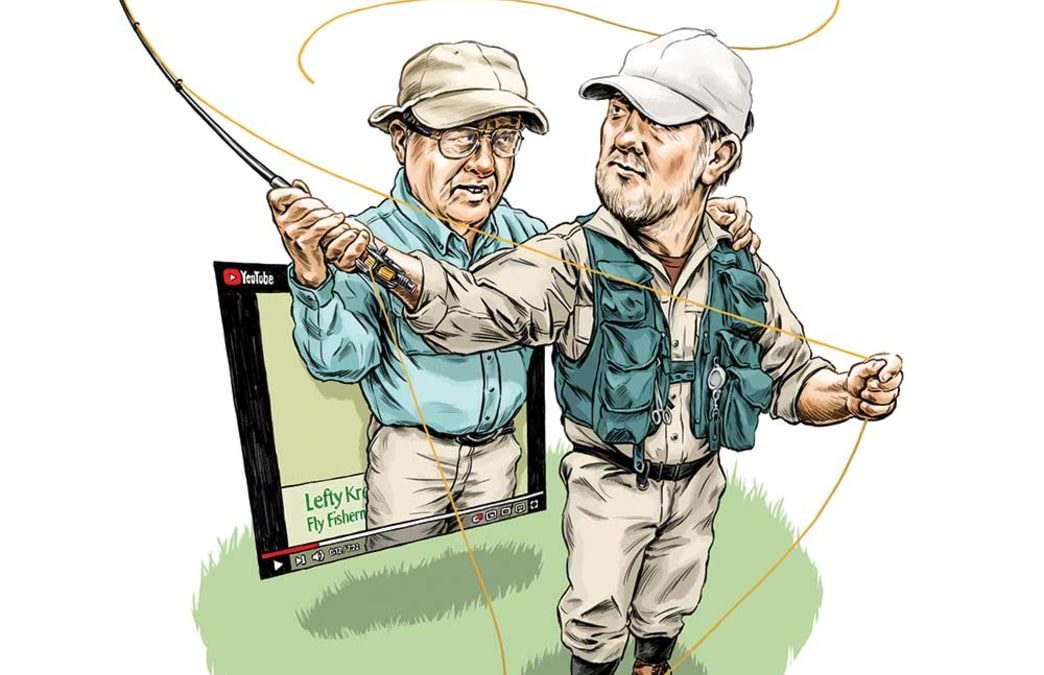
I knew I’d have to modify my fly-casting stroke while I regained strength and range of motion, and it so happened that I was working on a tribute to Bernard “Lefty” Kreh, the legendary flyfishing angler and instructor who had passed away just a few months earlier. Watching YouTube videos of Lefty casting was a revelation. At more than 80 years old, the man could cast 80 feet of fly line with all the drama of opening a can of soda. As I pecked away, one-handed, on my story, I thought: If I have to relearn a little, maybe I should start at the beginning.
After all, I’d been thinking about the mechanics of my fly casting for a while. For years, I had been using a Kreh-like total-body casting stroke, but as I threw ever-heavier lines with ever-heavier rods, all sorts of unnecessary gesticulations crept into my style. I had begun raising my casting arm to squeeze more rotation from the shoulder. I would punch the rod forward like I was taking an angry swing. I could sense that my casting was getting out of hand, and then I had a chat with Flip Pallot, the second most famous flyfisherman of all time. He told me that in 1964, when he was already a hotshot South Florida flyfishing guide, he saw Lefty cast an entire fly line with his bare hands. “I knew right then,” Pallot told me, “that I might know how to catch fish on a fly, but I didn’t know shit about fly casting.”
It was, most likely, the only time that Pallot and I will ever feel the same way about our casting skill. It was time to go back to school.
Casting Calls
Over the next few weeks, I propped my laptop on a chair in the backyard, pulled out a rod, and let virtual Lefty reteach me how to cast. He espoused what he called the Four Principles of Fly Casting. Like gravity, they could be neither altered nor ignored. Most are standard fare among casting instructors: The fly must be moving before you begin the backcast. Don’t bend your wrist, or you’ll waste a cast’s energy by throwing the line in a curve. The line will continue in the direction where the rod tip stops.
But it was Lefty’s “head to toe” casting style that set him apart from many. He eschewed the metronomic 10 o’clock to 2 o’clock cadence that most fly casters first learn. From the shade of my pecan tree, the World War II veteran dismissed this as “saluting.”
“What are you, a windshield wiper?” YouTube Lefty asked. “In no other sport do you only use your hand and arm. From Frisbee to ping-pong, you use your whole body.”
For Lefty, the perfect fly cast started at the ankles, knees, and waist as he twisted 45 degree away from the target and brought his casting arm behind his shoulder. He waited for the fly line to flatten out behind him, then he'd reverse courdse, with a smooth forward cast that picked up speed from starts to stomp-on-the-brakes finish.
For Lefty, the perfect fly cast started at the ankles, knees, and waist as he twisted 45 degrees away from the target and brought his casting arm behind his shoulder. He waited for the fly line to flatten out behind him, then he’d reverse course, with a smooth forward cast that picked up speed from start to stomp-on-the-brakes finish.
I mimicked his power stroke, threading the fly line in the open airspace between the back deck and the pecan. I had to raise the rod tip a smidge for the line to clear the neighbor’s fence on the backcast, but I’m sure Lefty understood that I was working in a tight space. But otherwise, he let nothing slide. He admonished my hand position on the cork. “Thumb behind the target!” He called out my snapping strokes. “Accelerate through the stroke! You don’t have to work any harder to cast 60 feet than 20 feet!”
I practiced turning my body toward the backcast and keeping my elbow low. “Don’t ever lift it off the shelf,” Lefty explained as I replayed the clip a dozen times. I started my casts farther back, focusing on a smooth acceleration from start to finish.
“That’s right!” Lefty hollered out, both to me and to some young woman standing by a farm pond on the computer screen. “Casting too hard is how you get wind knots when there ain’t no wind!” We practiced day after day as Lefty admonished me from the bow of a flat skiff in the tropics, from years and decades long past. My wrist began to complain less and less, and my fly line loops tightened.
“You don’t cast a fly line, you unroll it…. A backcast ain’t nothing but a forward cast going the other way…. Get the fly moving!” Lefty barked from the laptop’s tinny speaker.
A month later, laptop Lefty was, unfortunately, nowhere to be found. I motored out of North Carolina’s Beaufort Inlet with a grimace; a 20-knot wind chopped the water into 3-foot waves, each curl capped with white foam. Scattered schools of Spanish mackerel and false albacore popcorned around the tide break, but the fish were up and down so quickly, you’d miss every chance with a four-stroke false cast. I eased upwind of the fish and listened to Lefty’s words in my head. I slowed each cast down. With my arm locked to an imaginary shelf, the cast’s low center of gravity helped keep my feet bolted to the hull. I turned my body toward the backcast, Lefty-style, and smoothly delivered a 40-foot zinger with a single backcast. I practically felt his hand slapping my back.
Then I missed the only solid strike I’d have that morning. I set the hook too early and practically ripped it from a mackerel’s mouth. Flustered, I heaved on the rod for the backcast instead of stripping the fly tight, and pulled a spaghetti wad of gnarled line straight into the hull. I had to laugh. If Lefty were watching, I knew what he’d say. I’d heard it a dozen times before.
“God ain’t gonna let you cast until you get the end of the line moving,” Lefty preached. “He just ain’t.”
So it was back to the basics. Seems like that always works best.
Gear Tips: Hot Rods
It isn’t suitable for every fishing situation, but the Sage Igniter rod series does what it is designed to do with a ferocious punch: deliver heavy lines and heavy flies through strong winds and over long distances. And it’s not just for the salt: A super-fast blank taper and light feel make these rods a potent tool for all-day casting from a drift boat.
Written by chillman for Field & Stream and legally licensed through the Matcha publisher network. Please direct all licensing questions to legal@getmatcha.com.
Even in the middle of a “bomb cyclone” storm, the bonefishing at Abaco Lodge is still a fly angler’s paradise
Fly rods Kelly Bastone
As the bonefish bulleted away with my line , my heartbeat seemed to lurch into fast-forward. Here in the Marls, a 300-square-mile expanse of tropical flats off the west coast of the Bahamas’ Great Abaco Island, the fish must’ve sensed that it could run forever. I let the reel whir until the line slackened slightly, then I cranked like mad to haul it back.
The fight went back and forth like this for two marvelous minutes before my rig suddenly slackened altogether. Looking at a straight rod, I realized I’d lost my fish. I felt cheated enough to howl.
“Nothin’ you coulda done about that,” said Travis Sands, who was poling me around the shallows beyond Abaco Lodge. Living in Colorado, I’ve lost my fair share of trout for reasons both obvious and inscrutable, and I know that breakoffs are just part of the game. But apparently, I’d hoped angling’s laws might work differently down here in the Bahamas. And we’d seen so few fish that day that I worried I might’ve flubbed my only chance to bring a bonefish to the boat.
Grey Ghost Paradise
This was my first trip to the Bahamas, and I expected warm temperatures—or at least sunshine and those blue-opal waters found nowhere else. But as luck would have it, the same weather system that was dumping January’s “bomb cyclone” on the mid-Atlantic coast was also roiling the water here at Abaco Lodge, situated on the labyrinth of mangroves and mud flats known as the Marls.
These vast swaths of shallow water hold huge numbers of bonefish, which helped earn this area its National Park designation in 2015. Marls fish, on average, aren’t huge—5 pounds ranks as big—but they are plentiful. In May and June, Sands tells me, the fish are so thick that you can’t wade without kicking them.
That’s what prompted Oliver White to establish Abaco Lodge in 2009. A globetrotting angler and adventurer, White has scouted fisheries from French Polynesia to Guyana, and he knows an uncorrupted gem when he sees one. So, when he stumbled upon a ramshackle waterfront property on the west coast of Abaco Island, on the Marls’ very doorstep, he rounded up some investors and turned the dilapidated former hotel into an 11-room fishing lodge and dock.
Abaco Lodge bahamas bonefishing Kelly Bastone
The lodge lounge is comfy (its sofas are flanked by an open bar and a big-screen TV) and the décor is sleek but relaxed: The small waterfront yard includes both a fire pit and a black stone swimming pool. But direct access to the flats is the lodge’s standout feature. Instead of having to trailer a boat to the put-in (as most Abaco Island anglers do), guests at Abaco Lodge roll from coffee to dock—and in the afternoon, from dock to Kalik lager—with a 15-second commute.
Fishing from the dock wasn’t an option when I arrived, though. Whipping winds, grey skies, and cold, murky water sent the bonefish fleeing to warmer depths. But as Sands and I set out on his flats skiff on the first of three days, he seemed cavalier about the unfavorable conditions. “We’ll find some,” he assured me. He beamed even brighter when I selected a dun-colored Coyote Ugly shrimp fly that Drew Chicone had sent me for this trip. (The author of the book series Top Saltwater Flies, Chicone has taught fishing workshops from Abaco Lodge and knows what works on the Marls.)
With the wind consistently topping 20 mph, Sands chose to hug the tall, pine-covered coast of Abaco proper rather than venturing into the low-lying mangrove islands offshore. We spent the morning drifting through sheltered bays that warmed up quickly during the brief periods of sun that let us peer into the water. Even then, we saw almost no fish.
“All the little guys are afraid of getting beached, so they’re hanging out in the deep,” Sands said, explaining that wind affects these depths even more than the tides and that only the bigger bones feel comfortable enough to feed in such changeable water. Targeting giants struck me as a fine idea, but the fish I eventually hooked (and lost) was mid-size at best, and thickening afternoon clouds shut down the action altogether. That day’s consolation prize was conch fitters and buttered lobster tail back at the lodge.
Abaco bonefish caught with coyote ugly fly Kelly Bastone
Last Cast
The next morning I stepped onto the dock to find that the water was clearer but the wind just as strong. My guide Michael Taylor (guests at Abaco Lodge fish with a different guide each day) ran us 20 minutes offshore into the gust-hammered Marls. For four hours, we searched the roughed-up water for fish. We glimpsed no other boats, no shred of any human evidence anywhere in the vast, open flats. Mesmerized by the immensity, I stared at the mangroves’ arcing legs, and tried to conjure fins.
Finally, we spied a trio of big, brawny bones feeding hard along a sandy beach. Taylor brought me within 30 feet of them, but I couldn’t handle the crosswind, and we soon watched the three bonefish zipping away. The next pod we located offered easier casting with a tailing wind, and two long strips after I laid down my Coyote Ugly, I felt the tug of a hooked bone. The photos we took reveal it to be an average-size fish, unremarkable in any visible way. But as I leaned over the hull and cradled its belly in my fingers, the fish seemed like a staggering gem. Exhilarated to have driven the skunk off this trip, I decided that catching any additional fish would be gravy.
Author fighting bonefish Hilary Hutchenson
Thing is, I soon found myself hungering for heaping helpings of that gravy, and my final morning at Abaco seemed likely to serve it up. Clouds persisted but the wind had died, presenting us with glassy water that spotlit tailing fish. Ashron Williams, a third-generation bonefishing guide who was born and raised on Abaco Island, poled us through the Marls’ watery crannies.
“A lot of guides are afraid of the Marls,” said Williams, who’s logged so many miles on these flats that he long ago lost any qualms about getting lost or stuck aground. Within minutes of cutting the motor, he spied a small school of bonefish feeding against the mangroves. I dropped the fly silently, but too far to the left.
“Leave it,” Williams said. Holding my breath, I watched the lead fish munch its way toward my Coyote Ugly.
Tailing bonefish Joe Cermele
That’s the great thing about fly-fishing in the Bahamas: These smooth, sand-bottomed flats are more forgiving than reefs. Bonefishing in Belize, for example, demands absolute accuracy, because letting the hook rest on the bottom is likely to get you snagged on a coral head. But the Marls let me be more approximate with my casts. Once the fish finally nosed toward my line, all it took was one long strip to spark a chase. The hooked bonefish rocketed toward the mangroves, but I managed to steer it back toward open water and reel it to the skiff.
As the day stretched on, we never did spot the massive pods of bonefish that the Marls are famous for, but the fish we did ambush were greedy eaters. My friend hooked a bone on his second presentation, after the fish refused the fly on the first pass. And most of the fish we caught were bigger than the Marls’ 3- to 4-pound average.
The biggest, though, made those mid-size fish look like guppies. Williams spotted it form 100 yards, tailing 6 feet off a skinny crescent of sea-lapped sand.
“There’s three of them, at 11 o’clock,” he said.
As we began our silent, slow chase, I kept my eyes fixed on the trio of tails jutting out of the glassy water, like tiny black-edge flags flutter in a languid breeze. Finally, we drew close enough to make out their bodies underwater. The lead fish was a giant—8 or 9 pounds, Williams estimated—and feeding hard. I unleashed my fly, made two false casts, and dropped the fly right where I wanted, about a foot beyond the fish’s nose.
Releasing bonefish Alex Suescun
Or, so I thought. The moment my fly hit the water, I watched the three biggest fish sprint away from the boat, spooked. My presentation would’ve been perfect for the 4- and 5-pounders we had been seeing, but this bonefish was twice as long, and I misjudged the distance between its wake and its mouth, inadvertently landing the fly on its back.
“With the really big bones,” Williams said, “you’ve got to lead them more than you think.”
I lost that trophy. But next time, I promised myself, I’ll parlay the lesson to win.
Written by Kelly Bastone for Field & Stream and legally licensed through the Matcha publisher network. Please direct all licensing questions to legal@getmatcha.com.
Looking for the perfect trout stick? An understanding of how rod performance determines price will help you pick the best rod no matter how much you want to spend
Walk into any fly shop from the Rockies to the Catskills and you’ll see a wall or two full of trout rods. Most shops carry a half-dozen brands at least, and the prices range from the bare-bones value of rods like the ECHO Base, all the way to the pricey G. Loomis Asquith. I’ve spent my entire life chasing trout in the American West, and I’d like to think I know a thing or two about “good” trout rods. I’ve also had the opportunity to fish many different rod brands across a wide spectrum of price ranges. Of course, “good” and “bad” are subjective terms, but using them to describe rods boils down to whether or not a fly rod puts your fly where, how, and when you wanted it. It’s the performance aspect of fly rods that creates the price disparity. But does that price difference automatically mean an expensive rod will put your fly on the water, exactly how you want, as accurately as possible, every time? Not entirely. A competent angler can work with an incompetent rod. If you’re in the market for a new trout rod, here’s what to consider when figuring out which one is right for you, based on everything from budget to your preferred style of fishing. First and foremost, you have to understand that what creates the price differences among trout rods comes down to these three features:
Blank Quality
A high price tag almost always correlates to a fly rod blank that’s lighter and stronger than cheaper rods. Winston’s new AIR rod family is a great example to use here. The AIR utilizes Winston’s blend of boron graphite and a new resin (the glue that holds graphite together), which supposedly dries lighter, meaning you’re fishing a lighter rod. The AIR retails for $950 – a hefty price tag. But when compared to the company’s new Kairos—which goes for $475—you can immediately notice the difference in rod weight and overall feel. Blank quality is the biggest factor in pricing a rod.
Blank Performance
This is a tricky aspect to quantify because performance is such a subjective term, and it’s devilishly hard to accurately measure. What is measureable, though, is how a blank tracks and deflects. A rod with high torsional stability (meaning the tip stays in a relatively straight line as it moves on your front and back cast) that doesn’t oscillate will, in the right hands, be more accurate than a rod that’s not built with those major features in mind.
Build Quality
Just like the majority of flies are tied to catch fishermen more so than fish, rods are built to draw attention while on the shop rack. From the bright green of the Sage MOD to the trademark unsanded finish on Scott rods, every company has some signature build quality meant to make a rod fit for the classiest of tweed-clad trout anglers. Joking aside, the quality of a rod’s cork, guides, thread wraps, and hardware quickly add up to a bigger price tag. They don’t drastically impact how a rod performs, but I’d be a liar if I said I didn’t appreciate well-built rods. It’s a lot like hunting rifles, honestly. A composite stock doesn’t make a gun better than one with a real wood stock, but something about solid mahogany or walnut just feels better.
Budget and use are two key factors you must consider before walking into the fly shop. Ryan Kelly
Now that you have a better understanding of what sets the price of a fly rod, consider these factors before walking into the fly shop:
Budget
How much are you willing to spend on a rod? Go in with a firm idea because that will hugely narrow down your search for the perfect rod.
Use
What do you plan to use this rod for? Is it your .30-06, ready to tackle just about every situation you come across? Five-weight rods are the go-to for most trout anglers, myself included, and are largely considered the best all-around weight. Four-weight rods are lighter and a top choice for devout dry fly anglers, and a heavier, faster 6-weight is the standard stick for guys that like to strip larger streamers all day or dredge nymphs on weighted rigs. When you clearly define the use of the rod you’re going to buy, your options will narrow even further. However you fish, make sure the rod you buy matches your style. You’ll appreciate your investment that much more if you buy something suited exactly to your standard trout fishing needs.
Once you’ve answered the above questions, and taken into account what aspects of a rod are most impactful in rod performance, you’re ready to start shopping. The following list is a great starting point for finding the rod you want at the right price. I’ve personally fished each and every one of these sticks, and while there are many, many others on the market, my field test findings may help guide your decision. Whichever rod you end up with, make sure to keep it clear of car doors, clean the dirt from the ferrules, and catch some trout with it. No matter how pretty or expensive a rod is, as late master rodsmith Tom Morgan himself told me, “Rods are meant to be fished.”
Written by Spencer Durrant for Field & Stream and legally licensed through the Matcha publisher network. Please direct all licensing questions to legal@getmatcha.com.
Duunnn, Dunnn… Here are the tackle and tactics you need to go hunting for jaws
When nearshore water temperatures reach their summertime peaks, species such as striped bass, big bluefish, and red drum leave the surf until the fall. What many surf anglers don’t realize, however, is that the same sweltering temperatures that drive out the stripers and reds draw in brown sharks, blacktips, and spinners. From July 4th to Labor Day, these sharks swim within casting range of beaches from Massachusetts to North Carolina. If you’re willing to put in the time, these toothy surf prowlers can provide some of the most memorable battles of your life. Here’s how to play.
1. Beach-Bum Tackle
The surf sharks of the mid-Atlantic and Northeast average 3 to 6 feet long and top out at around 100 pounds, making them the perfect size for the same tackle used to throw bait at stripers or reds. A 10- to 12-foot rod rated to throw up to 8 ounces will tame most of the sharks you’ll encounter—but there is a chance that you’ll hook something big enough to spool your reel. Reels with a bait-feeder feature allow the sharks to swim off with the bait without feeling any resistance and also provide insurance against having your sand spike uprooted and your entire combo dragged into the surf.
2. Down to the Wire
To prevent bite-offs, use a leader of single-strand wire, such as Malin Hard-Wire No. 8 or 9. But make sure the leader is no more than 10 inches long, otherwise the weight and bait will helicopter on the cast, which will kill your distance. To prevent line abrasion against the shark’s sandpaper-rough skin, use an 8- to 10-foot length of 80- to 100-pound-test monofilament shock leader between the wire and your main line. If that main line is braid, an FG knot is a great choice for creating a low-profile connection that will slip through the rod guides easily.
3. Baiting Game
Frozen bait produces weaker scent and falls off the hook faster than fresh bait, so before a shark outing, hit the beach with your light-tackle outfit to catch croakers, spot, and small bluefish. Sharks hunt these fish, and a fresh-cut chunk from any one of them won’t go untouched for long.
4. Circle of Life
Several of the shark species commonly encountered in the summer surf are protected. Check state and federal regs first. If you hook into a protected species, it must be quickly released unharmed. To improve a shark’s chance of survival, use circle hooks. When you’re landing a shark, pull it just beyond the reach of the breakers. Leaving the shark in the wash will make the release easier on you and the fish, and a properly seated circle hook should be easy to remove with long-nose pliers. In the event of a deeper hooking, use wire cutters. Snip the leader close to the hook and send the shark on its way.
5. Close Encounters
The best time to catch a surf-cruising shark is from late afternoon through the first few hours of darkness. The fading light brings the fish in shallow to feed, and the late-afternoon hours tend to see a spike in the numbers of kingfish, croakers, and snapper bluefish in the waves. It’s important to remember that sharks can come in close—very close—to the beach, so you don’t need to bomb a cast 10 miles to reach the zone. Instead, target areas with deeper troughs running close to the surf line, and don’t be afraid to throw short, just past the first break.
Written by Jimmy Fee for Field & Stream and legally licensed through the Matcha publisher network. Please direct all licensing questions to legal@getmatcha.com.